The Midpoint Method
A Zodiac Boundary System for True Sidereal Astrology
The Midpoint Method is documented formally, with the full reduction chain from primary Hipparcos-2 catalog data, in: Chimenti, A. (2026). The Midpoint Method: An Ecliptic-Based Boundary System for Zodiacal Constellations. Zenodo. https://doi.org/10.5281/zenodo.20747017

True Sidereal Astrology is a modern approach to astrology that aligns zodiac signs with the real stars and constellations in the sky. Unlike mainstream astrology, which divides the zodiac into 12 equal 30-degree slices, true sidereal astrology uses the actual sizes and positions of the constellations - as they are seen in the sky.
Since there are no clear divisions between constellations, this leads to a key question:
Where exactly do the signs begin and end?
This is where the Midpoint Method comes in. The Midpoint Method is a system for defining zodiac boundaries within the true sidereal zodiac. It uses real stars, measured along the ecliptic (the Sun’s apparent path), to calculate the transition points between each zodiac constellation.
Why the Midpoint Method Was Developed

Most zodiac systems, including both mainstream tropical and sidereal, divide the signs into fixed 30-degree segments - creating artificial boundaries that do not reflect the actual sizes or positions of constellations.
Some true sidereal astrologers try to correct this by using constellation boundaries from the IAU (International Astronomical Union). But the IAU boundaries were created for astronomy, not astrology. Its boundaries are based on right ascension and declination - coordinates used to map the entire sky - rather than ecliptic longitude, which follows the Sun’s path and forms the basis of the astrological chart.
In astrology, the zodiac chart is the ecliptic, so zodiac boundaries must follow the ecliptic to accurately reflect the positions of the Sun, Moon, and planets.
The Midpoint Method solves this by:
- Anchoring boundaries to the ecliptic, the core reference line in astrology.
- Choosing ecliptic boundaries that are halfway between constellations.
How the Midpoint Method Works
Step 1: Work Along the Ecliptic
Since astrology is based on the ecliptic, the Midpoint Method uses ecliptic coordinates only. This ensures that the zodiac aligns with how the Sun, Moon, and planets actually move across the sky.
Stars are projected onto the ecliptic using their ecliptic longitude. These longitudes are used to define where one zodiac constellation ends and the next begins.
Here’s an example of how constellation stars are plotted along the ecliptic using their ecliptic longitude - the standard approach for working with fixed stars in astrology.

Step 2: Use Constellation Line Stars
Not every star within a constellation’s cluster is used - only the line stars, which are part of the visual shape (or stick-figure) of the constellation.
These line stars come from the two major constellation systems used today:
- IAU constellation lines (based on the Greek/Ptolemaic tradition)
- Vedic constellation lines (based on the Nakshatra and Rasi systems from Indian tradition)
While the IAU and Vedic constellation lines are very similar, they sometimes differ in which stars they include. For the Midpoint Method, the most important of these are the stars at the constellation edges, since they determine the boundaries.
When the edge stars differ between systems, the Midpoint Method selects the version (IAU or Vedic) that includes the outermost edge star. In other words, it chooses the figure that spans a broader section of the ecliptic to capture more of the constellation’s full size.
This ensures that no important line star from either tradition is left out when defining zodiac boundaries. It’s a way of honoring both cultural perspectives while maintaining continuity along the ecliptic.
By choosing the figure that better bridges the space between constellations, the Midpoint Method builds a more complete and inclusive zodiac - one that reflects the sky as it's been interpreted across both Western and Eastern traditions.
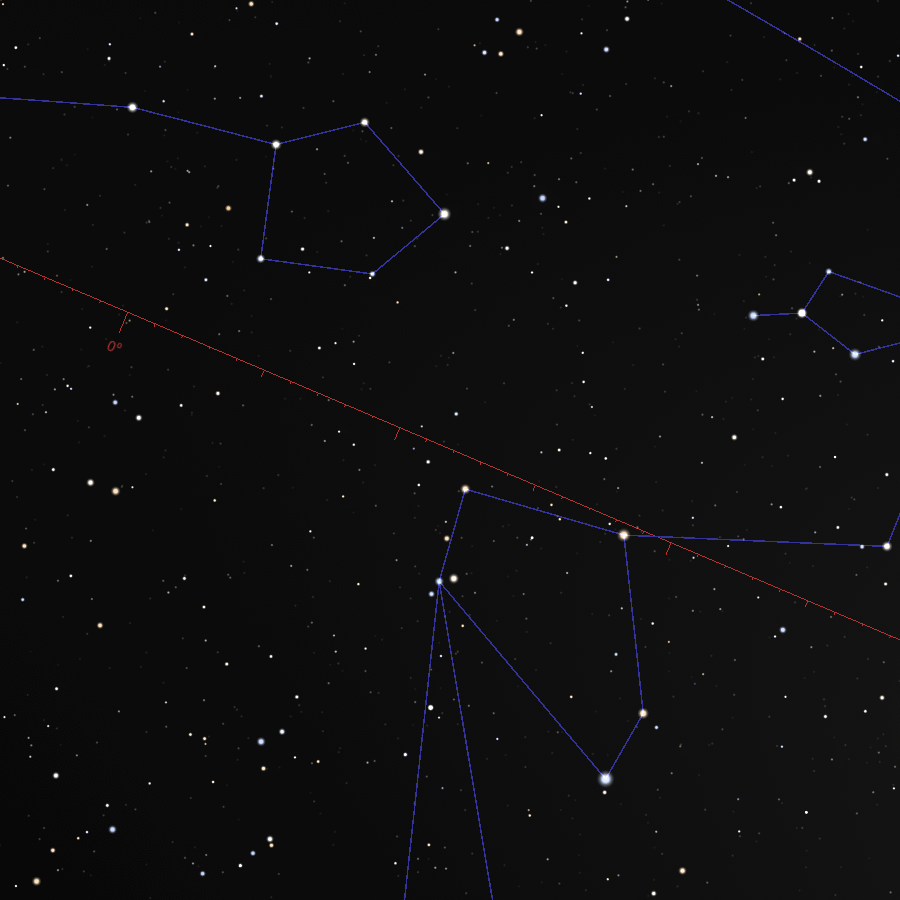
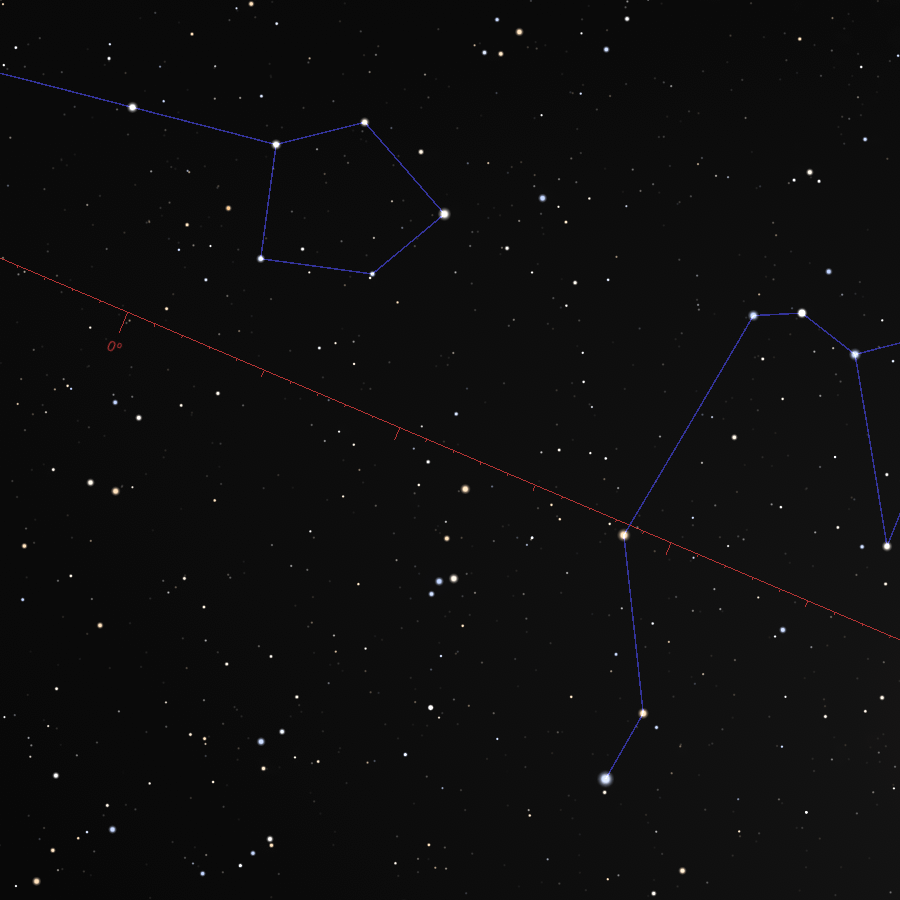
The images below illustrate the difference between the IAU (left) and Vedic (right) constellation lines at the end of Aquarius. Here, the IAU figure (left) is used because it includes the farthest-reach edge star, thus defining the outer limit of Aquarius along the ecliptic.
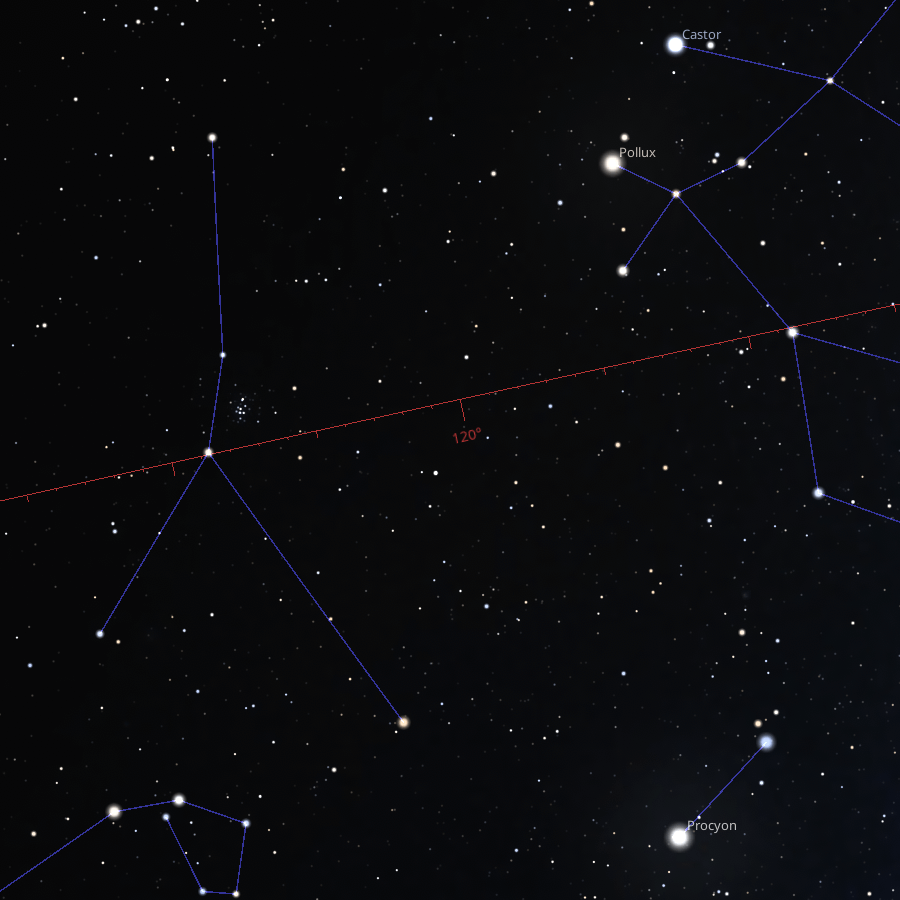
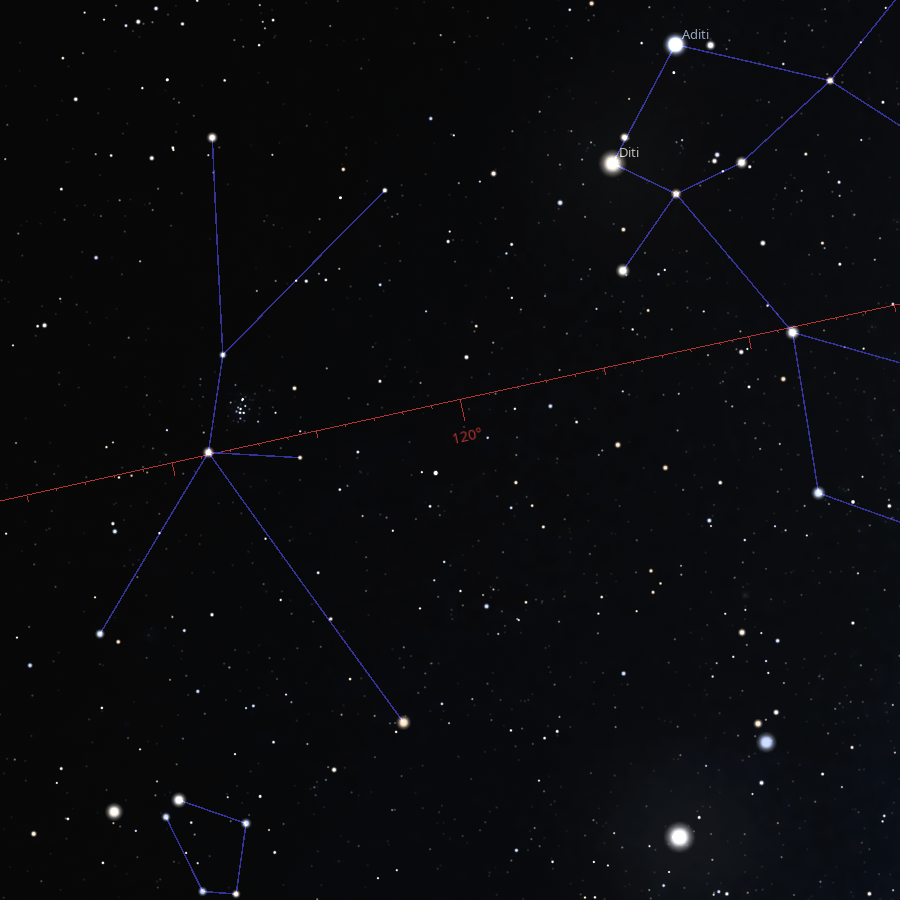
Another example below shows the constellation lines at the beginning of Cancer. In this case, the Vedic figure (right) is used because its top leg, Chi Cancri, is closer to Gemini than the IAU’s bottom-leg Beta Cancri.
Step 3: Set the Boundary by Calculating the Midpoint
To define a zodiac boundary, the Midpoint Method follows these steps:
- Identify the last line star of the previous constellation.
- Identify the first line star of the next constellation.
- Measure the ecliptic longitude of both stars.
- Take the midpoint between the two longitudes.
- That point becomes the zodiac boundary.

The midpoint is the cleanest and most objective place to divide two signs. It’s calculated using the actual stars that define each constellation - drawn from both Western (IAU) and Eastern (Vedic) traditions - and measured along the ecliptic, the standard path used in astrology to track planetary zodiac positions. By combining these principles, the Midpoint Method provides a precise and visually grounded way to determine which constellation the Sun, Moon, or planets occupy in an astrological chart.
The image shows the midpoint boundary between Libra and Scorpio. This boundary marks the halfway point between the last line star of Libra and the first line star of Scorpio.
Overlapping Constellations
In most of the zodiac, constellations follow a clean, non-overlapping sequence along the ecliptic. However, there are two cases - Capricorn-Aquarius, and Scorpio-Ophiuchus - where the constellation lines overlap. In these regions, stars from both constellations can appear to share the same area of the ecliptic, making it unclear where one ends and the next begins.
To resolve this, the Midpoint Method uses a simple filter: only stars within 10 degrees of ecliptic latitude (the vertical distance from the ecliptic) are considered when setting boundaries for any constellation involved in an overlap. This filter applies to both edges of such a constellation, since a figure that overlaps a neighbor cannot reliably be measured by stars far from the ecliptic at either end. This removes stars that are too far above or below the ecliptic and gives preference to the constellation that lies closer to the path of the Sun, Moon, and planets.
Additionally, though it should go without saying: an overlapping boundary star is only considered if it comes after the final star of the previous constellation. This has been implied throughout the method, since the constellations have naturally been in order, but it becomes especially important in cases where constellations overlap. It ensures that constellations are not broken up or rearranged out of sequence.

The image shows the Aquarius-Capricorn boundary. Sadalsuud in Aquarius has an ecliptic longitude slightly earlier than Deneb Algedi, the final star of Capricorn. Because the Midpoint Method requires signs to progress in order, Sadalsuud is excluded as a boundary marker. The next valid Aquarius star, Iota Aquarii, is used instead. This keeps Capricorn intact before Aquarius begins, preserving the natural flow of the zodiac along the ecliptic.

Here is the Scorpio-Ophiuchus boundary, showing how only stars within 10 degrees of ecliptic latitude are considered. For example, the Scorpio star Larawag is not used because it sits too far from the ecliptic - over 11.74 degrees in ecliptic latitude. Instead, Paikauhale is used as the final star of Scorpio, lying well within range at 6.12 degrees from the ecliptic.
The Midpoint Method Boundaries
The following table lists the edge stars, their ecliptic coordinates, and the calculated zodiac boundaries derived using the Midpoint Method described above. The coordinates listed use the J2000 reference frame, a standard astronomical system that fixes star positions as they appeared on January 1, 2000. To match the exact sky at a specific date and time, adjustments for the Earth's axial precession are needed. These adjustments are typically handled automatically by most planetarium and sidereal astrology software.
| Sign | Name | Longitude | Latitude | HIP ID | Boundary (Longitude) |
Boundary (Zodiacal) |
Sign Length | Tradition |
|---|---|---|---|---|---|---|---|---|
| Aries | Mesarthim | 33.1846 | 7.1624 | 8832 | 31.2816 | 0 | 19.7267 | IAU/Vedic |
| Aries | Botein | 50.8530 | 1.8240 | 14838 | Vedic | |||
| Taurus | Omicron Tauri | 51.1636 | -9.3342 | 15900 | 51.0083 | 19.7267 | 36.8572 | IAU/Vedic |
| Taurus | Tianguan | 84.7846 | -2.1956 | 26451 | IAU/Vedic | |||
| Gemini | 1 Geminorum | 90.9463 | -0.1726 | 28734 | 87.8655 | 56.5838 | 29.4539 | IAU/Vedic |
| Gemini | Kappa Geminorum | 113.6658 | 3.0786 | 37740 | IAU/Vedic | |||
| Cancer | Chi Cancri | 120.9730 | 7.4654 | 40843 | 117.3194 | 86.0378 | 17.1495 | Vedic |
| Cancer | Acubens | 133.6416 | -5.0804 | 44066 | IAU/Vedic | |||
| Leo | Al Minliar al Asad | 135.2961 | 10.4262 | 46146 | 134.4689 | 103.1872 | 38.4195 | IAU |
| Leo | Denebola | 171.6175 | 12.2669 | 57632 | IAU/Vedic | |||
| Virgo | Nu Virginis | 174.1592 | 4.5863 | 57380 | 172.8884 | 141.6068 | 49.7185 | IAU/Vedic |
| Virgo | Rijl Al Awwa | 220.1312 | 9.6721 | 71957 | IAU/Vedic | |||
| Libra | Zubenelgenubi | 225.0827 | 0.3331 | 72622 | 222.6069 | 191.3253 | 18.8784 | IAU/Vedic |
| Libra | 48 Librae | 240.3994 | 6.0855 | 78207 | Vedic | |||
| Scorpio | Dschubba | 242.5712 | -1.9861 | 78401 | 241.4853 | 210.2037 | 13.2279 | IAU/Vedic |
| Scorpio | Paikauhale | 251.4569 | -6.1204 | 81266 | IAU/Vedic | |||
| Ophiuchus | Sabik | 257.9696 | 7.1978 | 84012 | 254.7132 | 223.4316 | 12.3578 | IAU |
| Ophiuchus | 45 Ophiuchi | 262.8807 | -6.6292 | 85423 | IAU | |||
| Sagittarius | Alnasl | 271.2614 | -6.9912 | 88635 | 267.0711 | 235.7895 | 33.3912 | IAU/Vedic |
| Sagittarius | 62 Sagittarii | 297.0658 | -7.1062 | 98688 | Vedic | |||
| Capricorn | Algedi | 303.8586 | 6.9302 | 100064 | 300.4622 | 269.1806 | 25.6690 | IAU/Vedic |
| Capricorn | Deneb Algedi | 323.5426 | -2.6017 | 107556 | IAU/Vedic | |||
| Aquarius | Iota Aquarii | 328.7199 | -2.0810 | 109139 | 326.1312 | 294.8496 | 23.1646 | IAU/Vedic |
| Aquarius | Phi Aquarii | 347.1386 | -1.0524 | 114724 | IAU | |||
| Pisces | Gamma Piscium | 351.4532 | 7.2571 | 114971 | 349.2959 | 318.0143 | 41.9857 | IAU/Vedic |
| Pisces | Alrescha | 29.3787 | -9.0609 | 9487 | IAU/Vedic |
Reading Planets Near Sign Boundaries
While the zodiac boundaries in the table are calculated with high precision - down to four decimal places of ecliptic longitude - it’s important to underscore that this system is based on the visible sky and incorporates constellation lines from two different traditions. Since constellation lines vary between traditions, and because the stars themselves do not sit directly on the ecliptic, it’s not visually clear exactly where one constellation ends and the next begins. For this reason, a buffer of at least 3 degrees on either side of a boundary should be considered a transition zone. If a planet or point falls within this range, it should be interpreted as influenced by both zodiac signs. This approach honors the organic nature of the sky and supports an interpretation that blends both Western and Eastern traditions.
Summary: A Standard for True Sidereal Boundaries
The Midpoint Method offers a practical, sky-based solution to one of true sidereal astrology’s most fundamental challenges: where to draw the lines between zodiac signs. By using the visual constellation line stars from both the Western (IAU) and Eastern (Vedic) traditions, and calculating midpoints along the ecliptic, this method produces boundaries that are both astronomically grounded and astrologically relevant.
This system ensures:
- Alignment with the actual motion of the Sun, Moon, and planets along the ecliptic.
- Representation of constellations based on their visual figures.
- Respect for cultural wisdom from both Western and Eastern traditions.
- A cleaner, more objective way to measure the visual zodiac boundaries.
Ultimately, the Midpoint Method allows those working with true sidereal astrology to see and interpret the zodiac as it appears in the sky, while offering precision, clarity, and integrity in chart interpretation.
If you’re curious where your planets fall using this method, check out our online chart calculator and sky view. It’s built specifically around the Midpoint Method and offers a precise, sky-aligned view of your birth chart.
Or simply get your full report with e-reading.
The Midpoint Method is documented formally, with the full reduction chain from primary Hipparcos-2 catalog data, in: Chimenti, A. (2026). The Midpoint Method: An Ecliptic-Based Boundary System for Zodiacal Constellations. Zenodo. https://doi.org/10.5281/zenodo.20747017